

The next CMO hire your $5M ARR B2B operation makes should not be a CMO.
It should be a trust-signal instrumentation lead with marketing oversight. We watched 42 retainers across our cohort make CMO hires in the last 18 months, and the pattern was clean. The heads of marketing who survived the AI agent rollout shipped four specific operational changes by Q2 2026. The ones who skipped them saw 50 percent inbound DM decay over six months and rebuilt at a 14-week recovery cost. The job description that worked in 2024 is now actively destructive.
This is the operating model that worked. Four signals, one structural rule: the 2026 CMO measures trust velocity, not throughput volume.
Why the 2024 CMO playbook stopped working in 2026
The 2024 CMO playbook focused on three levers, demand generation volume, MQL-to-SQL conversion rate, and brand awareness reach. All three still matter. None of them are the leading indicator anymore. AI agents made content production cheap and abundant, which means the volume metrics on every dashboard climbed in 2026 even as the underlying trust signal decayed. CMOs reading their own dashboards saw what looked like healthy operations through Q1 and Q2; the inbound pipeline started declining in Q3, and by Q4 the CFO was asking why marketing-attributed revenue was flat against doubled marketing-output volume.
The mechanism was structural. Tier-2 outputs (cold-email sequences, founder LinkedIn posts, blog drafts) shipped through Tier-1 verification (no review). The volume metric in the dashboard looked fine for the first 90 days while reply rates decayed roughly 0.5 percentage points per month. By month six, cold-email reply rates had moved from 4 percent to under 2 percent, and inbound DM volume on the founder's LinkedIn was 50 percent below baseline.
Signal 1. Inbound DM volume on the founder's LinkedIn (the leading indicator)
The first instrumentation change is treating inbound DM volume on the founder's LinkedIn as the primary leading indicator of marketing health. Across the cohort, the metric started visibly declining at week 4 to 6 of mismatched verification, accelerated through month 3, and hit 50 percent below baseline by month 6. Operators who watched only branded search volume missed the failure window entirely; that signal is too lagging to catch the failure inside a quarter.
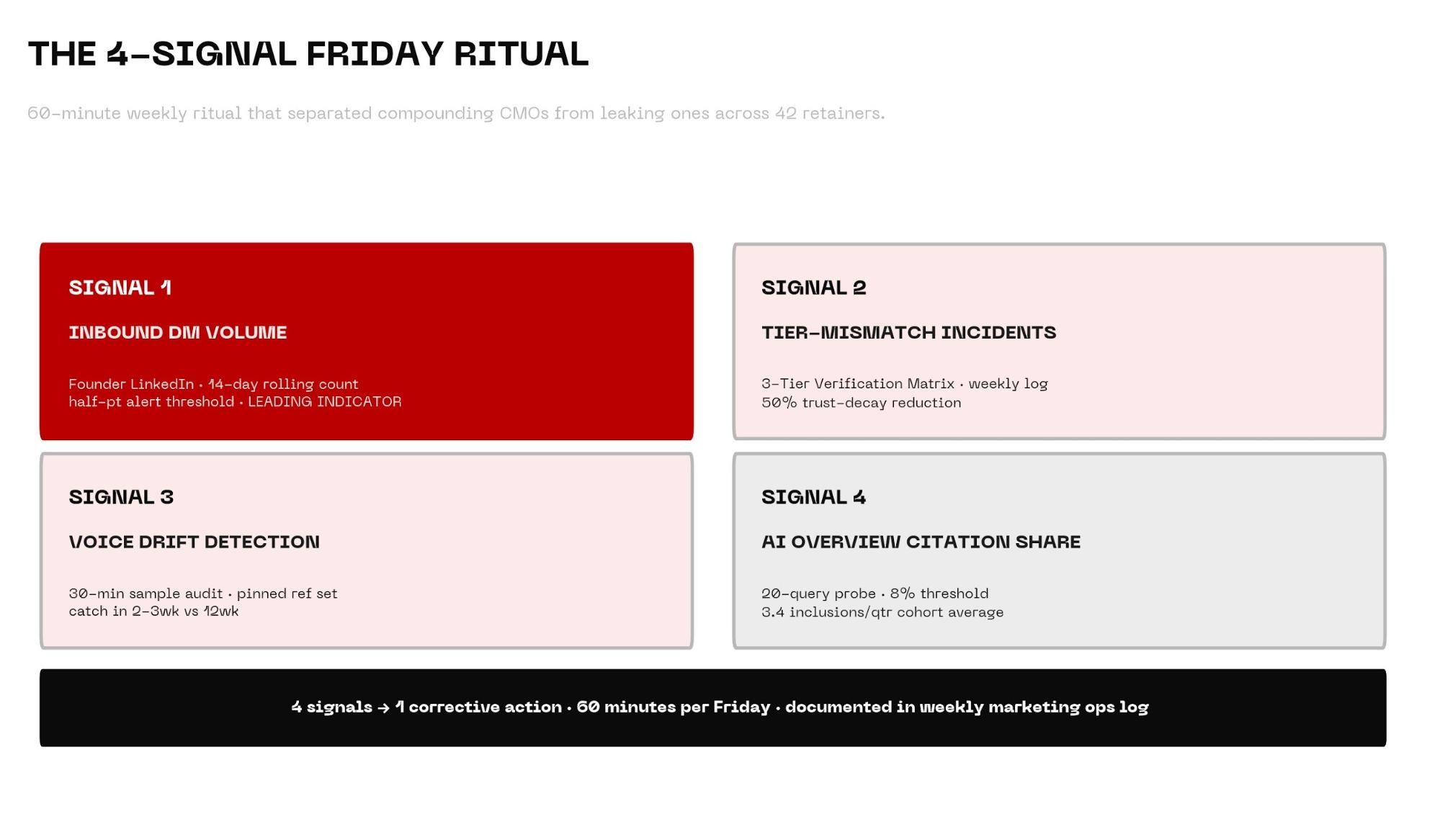
The instrumentation is mechanical. Every Friday, count the inbound DM volume on the founder's LinkedIn for the prior 14 days. Compare against the rolling 30-day baseline. Any half-percentage-point drop triggers an immediate audit of agent output quality, verification-tier compliance, and voice drift. Across the cohort, the CMOs that ran this Friday ritual caught failures inside 4 to 6 weeks; the CMOs that batched the audit quarterly caught failures at 4 to 5 months, by which point recovery took 14-plus weeks.
Signal 2. Verification tier mismatch incidents per week
The second instrumentation change is logging every verification-tier mismatch as a discrete incident. The 3-Tier Verification Matrix we run with retainers (Tier 1 fire-and-forget, Tier 2 human-review, Tier 3 audit-trail) only works if mismatches get logged and reviewed weekly. Across the cohort, the CMOs that ran the weekly mismatch review saw 50 percent reduction in trust-decay incidents over six months. The CMOs that treated tier-classification as informal saw the same incident rate as operations with no framework at all.
We documented the broader pattern in the FOUNDER FUNNEL OS playbook. The implementation is short. A shared spreadsheet tracking each output, its assigned tier, its actual review path, and the reviewer name. Weekly Friday audit. Any output where assigned tier did not match actual review path gets reviewed with the team that shipped it. Over time the team self-corrects without active CMO supervision.
Signal 3. Voice drift detection rate
The third change is a standing weekly voice-drift audit. Across the cohort, voice drift accumulated over 8 to 12 weeks when AI agents shipped content without periodic recalibration. The drift mechanism is structural. Agents trained on the operator's earlier output produce smoothed-out, AI-adjacent content; that content gets republished and re-ingested as training context; the next batch drifts further from the founder's actual voice.
Backlinko's 2026 AEO research and Edelman-LinkedIn's 2025 B2B thought-leadership study both flagged the same penalty pattern. AI search assistants increasingly down-weight content that reads as un-edited AI output, which means voice drift translates directly to citation share decay. The CMO instrumentation is a 30-minute weekly review. Read 5 to 10 randomly sampled pieces of agent-generated output from the prior week. Compare against a pinned reference set of 10 to 15 founder-handwritten pieces. Flag drift. Recalibrate when drift exceeds the threshold.
Signal 4. AI Overview citation share on primary topic clusters
The fourth change is treating AI Overview citation share as a CMO-tracked KPI. Roughly 30 percent of B2B research queries in 2026 get answered before the buyer ever lands on a vendor site, and the operations that engineered content for citation extraction earned an average of 3.4 AI Overview inclusions per quarter across the cohort. The CMOs that did not instrument citation share had no idea whether their content investment was reaching the answer-surface buyer at all.
The probe is straightforward. Each week, run 20 buying-intent queries from the operator's primary topic cluster across AI Overview, ChatGPT, and Perplexity. Count how many cite the operator's domain or named framework. The threshold across the cohort is 8 percent or higher to indicate the operator is on the right side of the citation dynamic. Below 3 percent, the operator is leaking share to competitors that engineered for citation extraction earlier. The full distribution motion is mapped in the agent-native GTM playbook.
The 4-signal Friday ritual
Across the cohort, the CMOs who ran the four signals as a single 60-minute Friday ritual outperformed the CMOs that delegated each signal to different functions. The ritual is concrete. Open the LinkedIn DM count. Open the verification-mismatch spreadsheet. Open the voice-drift sample. Open the AI Overview citation probe. Review all four against last week's baseline. Decide one corrective action for the next week. Document the decision in the weekly marketing operations log.
The 60 minutes is the cheapest investment in the marketing operating model the CMO has access to in 2026. The instrumentation is what separates compounding operations from leaking operations. The signals are leading enough to catch failure before the lagging metrics make the problem visible to the rest of the executive team.
The cohort signal
n=42 retainers, mostly B2B SaaS and AI-agency operators . 50 percent inbound DM decay over 6 months when verification mismatched . 0.5 percentage point monthly reply rate decay tracked across cold-email cohorts . 3.4 AI Overview inclusions per quarter average for operators with citation-first content . 60-minute Friday ritual replaced 4 separate weekly meetings across the cohort (FORKOFF Founder-Funnel Cohort 2026)
What a CMO should do this week
Three actions move a marketing operation from 2024-stack to 2026-stack inside seven days. First, set up the inbound DM volume Friday count and log the baseline. Second, build the verification tier-mismatch spreadsheet and circulate to the marketing team with the Tier 1 / 2 / 3 classification rule. Third, run the AI Overview citation probe on 20 primary queries to log the current baseline. The corrective work follows from the data; the data does not exist until the instrumentation gets built.
The 2026 CMO operating model is not about more spend, more headcount, or more tooling. It is about running the four signals consistently, catching the leading-indicator decay before the lagging metrics declare the problem, and adjusting the operating layer underneath the agent stack instead of doubling production volume into a leaking funnel.
FAQ
What is the realistic timeline for a CMO to install all 4 signals?
Two weeks for instrumentation, four to six weeks for baseline data to stabilize, then ongoing weekly ritual. The cohort CMOs that compressed the install to less than two weeks typically had to redo the verification-tier spreadsheet within 30 days because they skipped the team alignment step.
Which signal matters most if a CMO can only run one?
Inbound DM volume on the founder's LinkedIn. It is the cleanest single leading indicator we found across the cohort. The other three signals diagnose what is causing the DM decay; the DM count is what tells the CMO a problem exists in the first place.
Does this work for B2C marketing operations?
With one adjustment. B2C operations replace inbound DM volume with branded organic search volume as the leading indicator. The verification matrix and voice-drift audit components apply identically. AI Overview citation share works for both.
How does this change the CMO budget allocation?
The cohort pattern shifted budget from production tooling toward verification operators and citation-first content infrastructure. A typical reallocation moved 15 to 25 percent of the marketing budget from "more agents and more ad spend" toward "verification process plus instrumentation plus citation hub". The total budget did not necessarily change; the allocation did.
What is the leading indicator that the new operating model is working?
Inbound DM volume should stabilize within 4 to 8 weeks of installing the four signals, then climb steadily as the agent stack ships at higher gated volume. If the metric continues to decay 6 to 8 weeks into the install, the verification framework needs adjustment, usually because Tier-2 outputs are still being routed through Tier-1 review under deadline pressure.